Portuguese Numbers 1–100 (and How to Pay for Things in Portugal)
Published on 2026-07-02
"São seis euros e cinquenta." The cashier says it in under a second, you freeze, and you hand over a twenty-euro note just to be safe. Three transactions later, your pocket is full of coins and your confidence is not.
Numbers are the most-used vocabulary in any language, and in European Portuguese they come at you fast: prices, phone numbers, ticket queues, addresses. The good news is that the system is ruthlessly regular — learn about thirty words and you can build every number to a hundred. This guide covers the numbers, how prices actually sound, and the machine that runs Portuguese money: the Multibanco.
Portuguese Numbers 1–20: The Memorization Zone
These you simply learn — everything after them is assembly:
| # | Portuguese | # | Portuguese |
|---|---|---|---|
| 1 | um / uma | 11 | onze |
| 2 | dois / duas | 12 | doze |
| 3 | três | 13 | treze |
| 4 | quatro | 14 | catorze |
| 5 | cinco | 15 | quinze |
| 6 | seis | 16 | dezasseis |
| 7 | sete | 17 | dezassete |
| 8 | oito | 18 | dezoito |
| 9 | nove | 19 | dezanove |
| 10 | dez | 20 | vinte |
Two things to notice. First, um/uma and dois/duas agree with the noun's gender: um café, uma cerveja, dois pastéis, duas bicas. Everything from three up is genderless. Second, those teen spellings — dezasseis, dezassete, dezanove — are European Portuguese; Brazilian writes dezesseis. Small flag, real signal.
How Do I Count from 20 to 100?
Pick a tens word, add e (and), attach a unit. That's the whole system:
| Tens | Portuguese |
|---|---|
| 20 | vinte |
| 30 | trinta |
| 40 | quarenta |
| 50 | cinquenta |
| 60 | sessenta |
| 70 | setenta |
| 80 | oitenta |
| 90 | noventa |
| 100 | cem |
So: 21 = vinte e um, 47 = quarenta e sete, 99 = noventa e nove. One quirk at the top: 100 alone is cem, but the moment anything follows it becomes cento: 101 = cento e um, 150 = cento e cinquenta.
How Are Prices Said in Portugal?
Portugal writes prices with a comma — 6,50 € — and says them with one fixed pattern: euros, e, cents.
- 6,50 € → "seis euros e cinquenta"
- 1,20 € → "um euro e vinte"
- 0,80 € → "oitenta cêntimos"
- 12,75 € → "doze euros e setenta e cinco"
Cashiers compress this to a blur ("seiseuroscinquenta"). Two phrases keep you afloat:
"Pode repetir, se faz favor?" — Can you repeat, please?
"Pode escrever?" — Can you write it down?
And the question that starts it all — "Quanto custa?" (How much does it cost?) — switches to "Quanto custam?" for plurals, and at the till becomes "Quanto é?" (How much is it, total?). We cover the full checkout script in our Portuguese supermarket guide.
Advertisement
What Is the Multibanco, Exactly?
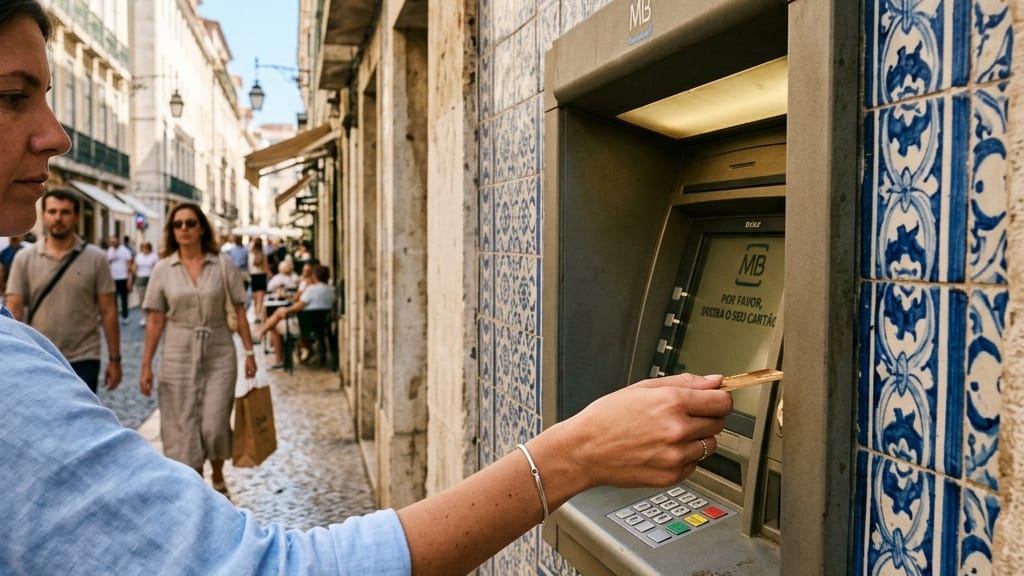
O Multibanco is Portugal's national ATM and debit network, and it borders on a public utility. From the same blue-and-white machine, Portuguese people withdraw cash, pay utility bills, top up phones, pay taxes, and buy train tickets. When a cashier asks "Pagamento?", the standard answer is simply "Multibanco" — meaning "by card."
The verbs you need:
- levantar dinheiro — to withdraw money ("Vou levantar dinheiro." — I'm going to get cash.)
- pagar com cartão — to pay by card
- pagar em dinheiro — to pay in cash
- aproximar o cartão — to tap the card (you'll hear "pode aproximar" — you can tap)
- o código / o PIN — the PIN
- o talão — the receipt slip the machine prints
Its mobile sibling is MB Way — the app Portuguese friends use to split a dinner bill by phone number. If someone says "manda-me por MB Way" (send it to me by MB Way), they're asking you to transfer your half of the bill.
The Numbers You'll Actually Hear This Week
A cheat sheet of real-life number moments:
- The senha screen: "Senha quarenta e dois!" — ticket forty-two, at any deli or pharmacy counter.
- The phone number: Portuguese numbers have nine digits, usually read in pairs or threes: nove-um-dois, três-quatro-cinco...
- The address: "Rua das Flores, número vinte e três, segundo esquerdo" — number 23, second floor, left door. Floors are ordinal: primeiro, segundo, terceiro.
- The year: dois mil e vinte e seis — 2026.
Quick Questions
Why do I hear "catorze" but see "quatorze" online?
Catorze is the European Portuguese spelling and pronunciation of 14; quatorze is Brazilian. Same with dezasseis/dezesseis (16) and dezanove/dezenove (19). If your app taught the second column, it taught you Brazilian.
Is Portugal cash or card country?
Card, overwhelmingly — Multibanco and contactless are accepted nearly everywhere, and MB Way covers person-to-person payments. Keep a few coins for market stalls, festival food, and the supermarket cart.
What's the difference between "Quanto custa?" and "Quanto é?"
Quanto custa? asks the price of an item (literally "how much does it cost"). Quanto é? asks for the total — it's what you say at the end, when the bill is being added up.
Do ATMs in Portugal have English menus?
Multibanco machines offer English, so survival is guaranteed. But the machine speaks Portuguese to everyone around you — knowing levantamentos (withdrawals) and o código (PIN) means never blocking the queue.
Want to drill numbers and prices until "seis euros e cinquenta" sounds slow? Our free lesson covers it all: Numbers, Prices & the Multibanco. And the rest of the beginner path is in our free European Portuguese lessons.
Advertisement
Start Learning Today
Join PortuTalk to unlock interactive lessons, listening exercises, and more.
Sign up for FreeNo credit card required.