
Shopping at a Portuguese Supermarket: Continente, Pingo Doce, and the Senha
Published on 2026-06-25
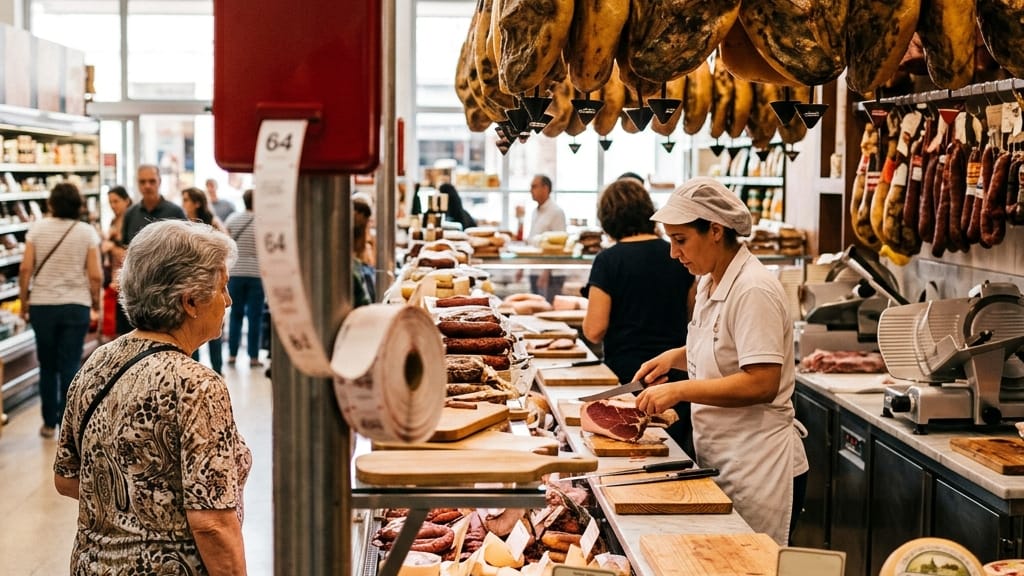
The first time I stood at a Portuguese deli counter, I waited politely for fifteen minutes while everyone who arrived after me got served first. Nobody was being rude. I had simply failed the supermarket's one secret test: I hadn't taken a senha — the numbered ticket that governs Portuguese counter service like a small, laminated constitution.
If you're settling into Portugal, the supermarket is where your European Portuguese gets its first daily workout. This guide covers the chains, the rituals, and the exact phrases you need from the parking lot to the checkout.
Which Supermarket Is Which?
| Chain | What locals say about it |
|---|---|
| Continente | The big one. Huge hypermarkets, strong loyalty card (o Cartão Continente) culture |
| Pingo Doce | Everywhere, good own-brand food, famous lunch deals at in-store restaurants |
| Lidl / Aldi | Same as everywhere in Europe, plus a middle aisle of mystery tools |
| Minipreço | Small neighborhood format, quick top-up shops |
| Intermarché | Strong in smaller towns, good butcher counters |
Two cultural notes before you walk in. First, the shopping cart (o carrinho) is usually chained up and needs a €0.50 or €1 coin — or a plastic token, which cashiers sometimes give away if you ask. Second, almost everyone carries reusable bags, because plastic ones cost money at the till.
How Does the Senha System Work?
Any counter with service — o talho (butcher), a peixaria (fishmonger), a charcutaria (deli), sometimes a padaria (bakery) — runs on numbered tickets. The ritual:
- Find the little red dispenser. Pull a ticket: a senha.
- Watch the screen for your number (o número).
- When it appears, step up and order.
If you've read our pharmacy guide, this will sound familiar — busy farmácias use the same system. The senha is one of Portugal's great unifying institutions.
At the counter, order by weight:
"Queria duzentos gramas de fiambre, se faz favor."
("I'd like two hundred grams of ham, please.")
"Pode ser meio quilo de carne picada."
("Half a kilo of ground meat is fine.")
That "pode ser..." (literally "it can be...") is the soft, natural phrasing locals actually use. The assistant may ask: "Mais alguma coisa?" (Anything else?) — to which "É tudo, obrigado" / "obrigada" (That's all, thanks) closes the transaction.
Weigh Your Own Produce (Usually)
In many Portuguese supermarkets, fruit and vegetables must be weighed before the checkout. Look for the scale (a balança) in the produce section: put the bag on, press the number on the price sign, and stick the printed label on the bag. In newer stores the checkout handles it — but if you're not sure, watch what the person next to you does. Arriving at the till with unweighed oranges earns you a walk of shame back to the balança.
Useful produce vocabulary:
| Portuguese | English |
|---|---|
| a fruta | fruit |
| os legumes | vegetables |
| as maçãs | apples |
| as laranjas | oranges |
| os tomates | tomatoes |
| a alface | lettuce |
| a balança | the scale |
| madura / maduro | ripe |
Advertisement
What Will the Cashier Ask Me?
The checkout (a caixa) is a rapid-fire listening exam with a fixed question list. Once you know the script, it stops being scary:
- "Tem cartão?" — Do you have a (loyalty) card? Answer: "Tenho" (I do) or "Não tenho" (I don't).
- "Quer saco?" — Do you want a bag? They cost €0.10–0.40 each. "Não, obrigado, trouxe." (No thanks, I brought one.)
- "Quer fatura com contribuinte?" — Do you want the receipt with your tax number? Residents give their NIF for tax deductions; "Não, obrigado" is fine.
- "Pagamento?" — Card or cash? "Multibanco" (card) or "em dinheiro" (cash) — almost everywhere takes card, and you'll hear "pode aproximar" (you can tap).
Then the goodbye: "Tenha um bom dia!" — have a good day. You: "Igualmente!" (Likewise!)
The Shelf-Label Decoder
A few words that save you from buying the wrong thing:
- biológico — organic (not "biological hazard")
- sem glúten / sem lactose — gluten-free / lactose-free
- em promoção — on sale (also o desconto, discount, often loaded onto the loyalty card rather than taken at the till — check your receipt)
- leve 3 pague 2 — take 3, pay for 2
- congelado — frozen
- o prazo de validade — the expiry date
Quick Questions
Do Portuguese supermarkets bag your groceries?
No. Bagging is your job, and the conveyor belt waits for no one. Locals develop impressive speed; you will too.
Why does the cashier ask for my "contribuinte"?
The NIF (tax number) on receipts lets residents claim small tax deductions. As a tourist you can simply say "não, obrigado." As a resident, getting asked for it five times a day is the national soundtrack.
What time do supermarkets close?
Big stores typically run roughly 8:30–21:00 or later, seven days a week, with shorter hours on holidays. Small-town stores may close for lunch — Portugal takes lunch seriously.
Is tap water and produce vocabulary enough to shop without English?
Honestly, yes — the supermarket is one of the few places you can complete an entire interaction with twenty memorized words. It's the perfect confidence-building arena.
Want this as a structured lesson with the senha ritual and counter-ordering grammar? It's free: Supermarket Survival. For everything else, browse all our free European Portuguese lessons.
Advertisement
Start Learning Today
Join PortuTalk to unlock interactive lessons, listening exercises, and more.
Sign up for FreeNo credit card required.