
Beach Portuguese: The Praia Vocabulary You Need This Summer
Published on 2026-07-30
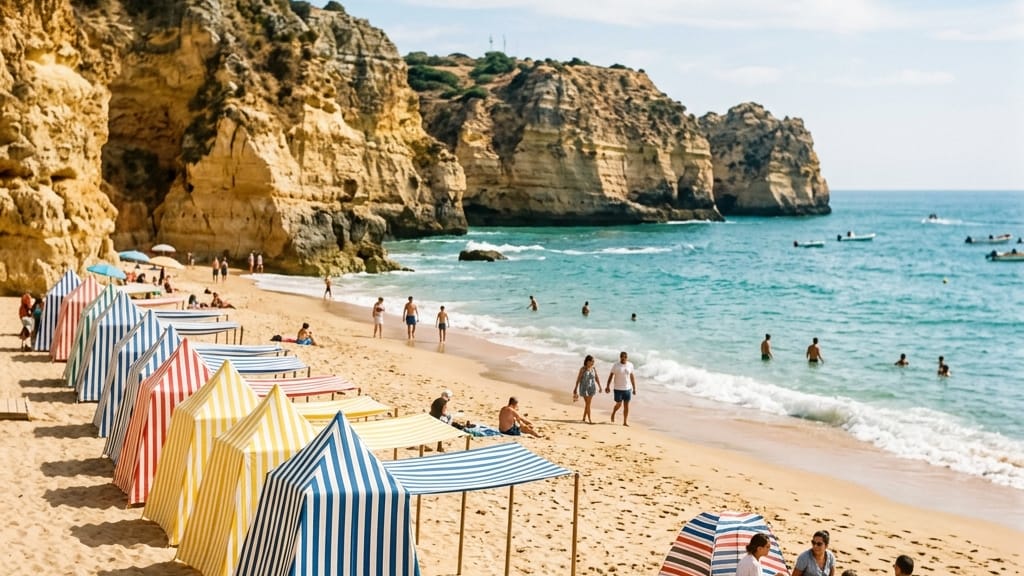
Every Portuguese beach day includes one sacred ritual: someone walks to the water, touches it with one foot, turns around, and announces to the entire beach — "A água está fria!" The water is cold. It is always cold. It is the Atlantic. The announcement must be made anyway.
If you're spending the summer anywhere on Portugal's coast, the praia (beach) is where the European Portuguese you've learned gets sunshine-tested: reading the flag, renting a sunshade, ordering at the beach bar, and joining the national conversation about water temperature. Here's the vocabulary that turns you from tourist to regular.
First, Read the Flag (Seriously)
Portuguese beaches are supervised with real authority, and the flag system is law, not suggestion:
| Flag | Portuguese | What it means |
|---|---|---|
| 🟢 Green | a bandeira verde | Swimming allowed |
| 🟡 Yellow | a bandeira amarela | Wading only — no swimming |
| 🔴 Red | a bandeira vermelha | Stay out of the water entirely |
| 🏁 Checkered | a bandeira xadrez | Beach temporarily unsupervised |
The person enforcing this is o nadador-salvador (the lifeguard — literally "swimmer-savior," one of Portuguese's great job titles). If a whistle blows and a flag points at you, the relevant verb is sair — "Saia da água, se faz favor!" (Get out of the water, please!). The Atlantic has serious currents; the lifeguards aren't decorative.
Other geography worth naming: a areia (sand), as ondas (waves), a maré alta / baixa (high / low tide), and o calçadão (the seafront promenade where everyone parades at sunset).
The Toldo Economy
A very Portuguese institution: on most equipped beaches, you can rent a toldo (a striped canvas beach tent), um chapéu de sol (a sun umbrella), or uma espreguiçadeira (a lounger — also one of the best words in the language to say out loud). The negotiation:
"Bom dia. Quanto custa o toldo por dia?" — How much is the tent per day?
"E só a espreguiçadeira?" — And just the lounger?
"Fico com o chapéu e duas cadeiras." — I'll take the umbrella and two chairs.
Families rent the same toldo for the entire month of August, in the same row, next to the same neighbors, every year. The toldo map of a Portuguese beach is a social document decades in the making.
Sun, Sand, and the Pharmacy Aisle
The sun vocabulary cluster, which doubles as a public-health announcement:
- o protetor solar — sunscreen. "Pões-me protetor nas costas?" (Will you put sunscreen on my back?) — beach intimacy at its most practical.
- apanhar sol — to sunbathe (literally "to catch sun")
- o escaldão — a proper sunburn. "Apanhei um escaldão." (I got fried.) The fix lives at the farmácia, and our pharmacy guide has the script for asking.
- a sombra — shade. "Vou para a sombra." (I'm moving to the shade.) — the wisest sentence on this page.
Advertisement
Beach Bar Portuguese
Lunch happens at o apoio de praia — the beach support bar — and it has its own menu dialect:
- uma bola de Berlim — the custard-filled doughnut sold by vendors walking the sand, announced with a singsong "olhá bolinha!" Buying one from a beach vendor is a rite of passage.
- um gelado — an ice cream
- uma água fresca / natural — cold water / room-temperature water (they will ask which; fresca means properly cold)
- uma imperial — a draft beer, ideally consumed with sea view (the full beer-ordering protocol, including what to say in Porto, is in our imperial vs. fino guide)
- uma sardinhada — a sardine feast, if the apoio has a grill and you have an afternoon
The beach-bar question you'll field in return: "É para levar ou para comer aqui?" — takeaway or eat here?
The Conversational Weather Report
Beach small talk is a fixed rotation of estar sentences — states, conditions, right-now observations:
- "Está muito calor hoje." — It's really hot today.
- "O mar está calmo / agitado." — The sea is calm / rough.
- "Está vento." — It's windy. (On the west coast: it is.)
- "A água está boa!" — The water's nice! (Said approximately twenty minutes after a água está fria, by the same person.)
If you've studied ser vs. estar, notice the pattern: the entire beach runs on estar, because the entire beach is temporary states. The Atlantic does not have an identity crisis; it just has conditions.
Quick Questions
Which word do I use: "praia" or "costa"?
A praia is the beach you sit on; a costa is the coastline as geography. You go à praia on Saturday; you live na costa if you're lucky.
Is the water really that cold?
Yes. Even in August, Atlantic water on the west coast hovers around 16–18°C; the Algarve's south-facing beaches run a few degrees warmer. The announcement ritual exists for a reason. Go in anyway — five minutes of bravery, then a proud "a água está ótima!"
What's a "bandeira azul"?
The Blue Flag — an EU-wide quality award for clean, safe, well-equipped beaches. Portugal has one of the highest counts in Europe; the flag flies at the entrance, separate from the safety flags.
Do I need cash at the beach?
For toldo rentals and walking vendors, yes — coins and small notes. The apoio de praia usually takes card, but the bola de Berlim economy runs strictly on cash.
Want beach and weather Portuguese as a structured lesson with the estar drills? Our free European Portuguese lessons have you covered — the beach lesson lands there next week, just in time for August.
Advertisement
Start Learning Today
Join PortuTalk to unlock interactive lessons, listening exercises, and more.
Sign up for FreeNo credit card required.