
Portuguese for Your AIMA Appointment: Documents, Questions & Polite Answers
Published on 2026-07-27
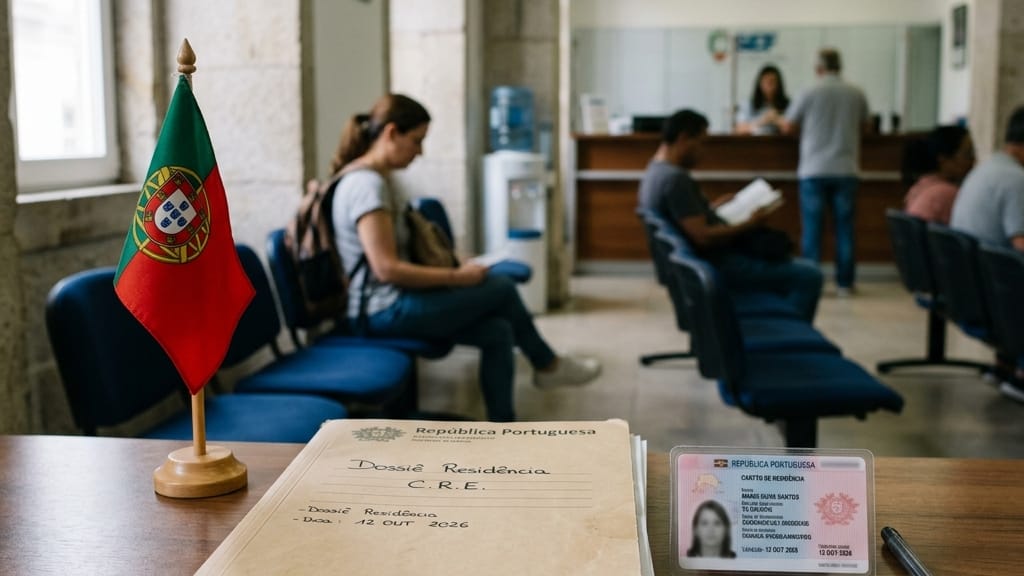
Nobody is calm in an AIMA waiting room. You've waited months for the agendamento, your folder of documents weighs half a kilo, and the entire appointment — the one your residence permit depends on — will be conducted in a register of European Portuguese your café conversations never prepared you for.
Here's the reassuring truth: AIMA appointments are linguistically narrow. The officer isn't going to discuss literature. They're going to ask for documents from a fixed list, confirm facts about your address and family, and tell you what happens next — all from a vocabulary of maybe forty words. Learn those forty and the appointment shrinks back down to what it actually is: paperwork.
What Is AIMA, and What's the Register?
A AIMA — Agência para a Integração, Migrações e Asilo — is Portugal's immigration agency, the successor of the SEF. Everything there happens in the formal register: you'll be addressed as o senhor / a senhora with third-person verbs, and you should reply the same way. No tu, no slang, and round everything off with se faz favor and obrigado/a.
One formal habit is worth installing before you go: confirm with verb + sim rather than a bare "sim":
"Tem o passaporte?" — "Tenho, sim. Aqui está."
("Do you have your passport?" — "I do, yes. Here it is.")
That little echo — tenho, sim — is polite, clear, and unmistakably the register of the room.
The Document Vocabulary That Runs the Appointment
Every AIMA conversation orbits the documents. This is the table to actually memorize:
| Portuguese | English |
|---|---|
| a autorização de residência | residence permit |
| o agendamento | the booked appointment slot |
| a morada | address (the official EP word) |
| o comprovativo de morada | proof of address |
| o agregado familiar | household / family unit |
| o NIF (número de contribuinte) | tax number |
| o NISS | social security number |
| o registo criminal | criminal record certificate |
| os meios de subsistência | means of subsistence (proof of income) |
| o comprovativo | supporting document / proof (of anything) |
| a renovação | renewal |
| o recibo | receipt (your proof the appointment happened) |
Two of these deserve a highlight. Morada is the word for "address" in all official Portugal — if you've been saying endereço, switch now. And comprovativo is the great bureaucratic noun: proof-of-anything. Comprovativo de morada, de matrícula, de pagamento — when in doubt, an officer is about to ask you for a comprovativo of something.
What Will the Officer Actually Ask?
The spoken core of the appointment is a short interview confirming your file. The greatest hits:
- "Tem o agendamento?" — Do you have the appointment confirmation?
- "Qual é a sua morada atual?" — What is your current address?
- "Quantas pessoas tem o seu agregado familiar?" — How many people are in your household?
- "Trabalha? O que faz?" — Do you work? What do you do?
- "Tem comprovativo de meios de subsistência?" — Do you have proof of income?
- "Vamos recolher as impressões digitais." — We're going to take your fingerprints. (Not a question — just follow the pointing.)
Model answers, in register:
- "Moro na Rua das Flores, número vinte e três, em Lisboa." — I live at...
- "Somos três: eu, a minha mulher e a nossa filha." — There are three of us: me, my wife, and our daughter.
- "Trabalho por conta própria." / "Trabalho por conta de outrem." — I'm self-employed. / I'm an employee. (That second phrase is pure bureaucratese — and exactly what the forms say.)
Advertisement
The Survival Lines for When It Goes Sideways
- "Pode repetir mais devagar, se faz favor?" — Could you repeat that more slowly, please?
- "Desculpe, não percebi. Pode explicar?" — Sorry, I didn't understand. Can you explain?
- "Falta algum documento?" — Is any document missing? (Ask it proactively — it shows command of the situation.)
- "Quando devo receber a resposta?" — When should I receive the answer?
- "Pode escrever isso, se faz favor?" — Could you write that down, please? (For reference numbers and dates, always.)
And the closer you hope to hear: "Está tudo em ordem." — Everything is in order. Followed, eventually, by a recibo — keep it like it's made of gold, because administratively, it is.
Why This Vocabulary Pays Twice
Here's the strategic part: this exact register — formal address, document vocabulary, polite requests — is also what the CIPLE A2 exam tests, and CIPLE is the language requirement on the citizenship road. Drilling for AIMA is drilling for the CIPLE exam, and the exam's role-play section reuses these same formal scripts — we've broken down the five role-plays worth practicing separately. One vocabulary list, two bureaucratic victories.
Quick Questions
Will AIMA officers speak English with me?
Some will, many won't, and none are required to. Bringing the Portuguese above — even imperfectly — changes the temperature of the appointment. Officers process dozens of nervous people a day; "Bom dia, tenho agendamento para as dez" starts yours differently.
Can I bring someone to translate?
Generally yes, and for complex cases it's wise. But the officer still addresses you, and the fingerprints, signatures, and confirmations are yours. The formal-answer formulas (tenho, sim / aqui está) keep you in the conversation even with a helper beside you.
What's the difference between "morada" and "endereço"?
Both mean address, but Portuguese officialdom says morada — it's the word on every form, and using it signals you've done this before. Save endereço for email addresses (endereço de email), where it survives.
How early should I arrive?
Early enough to find the right queue — many AIMA offices have separate lines for agendamento holders. The question to ask at the door: "É aqui para quem tem agendamento?" (Is this the line for people with appointments?)
Want the document vocabulary and formal register as structured practice before the big day? Browse our free European Portuguese lessons — the residency essentials lesson lands there this week.
Advertisement
Start Learning Today
Join PortuTalk to unlock interactive lessons, listening exercises, and more.
Sign up for FreeNo credit card required.